BWI Marshall Airport · Planned transfers
Baltimore Airport Car Service for BWI
Baltimore Airport Car Service is a BWI-first transfer operation: flight tracking, concourses A-E awareness, hourly garage pickup, cell-phone lot staging, and meet-and-greet when the arrival deserves a handoff.
Last updated: September 10, 2026
BWI-first dispatch
Pickup planning for BWI Marshall concourses A through E, the Hourly Garage, cell phone lot staging on Elm Road, and lower-level baggage claim door coordination.
Flight tracking
Share the operating airline and inbound flight number. Confirm the waiting start, delay handling and plan for a cancellation or diversion in writing.
Meet & greet available
Curbside on the lower level for speed; a chauffeur waiting inside baggage claim with a name sign when the arrival deserves a proper handoff.
Published hourly floors
Executive sedans start at $120 per hour, SUVs at $150, S-Class at $230 and Sprinters at $240, on a three-hour minimum. Airport transfers are quoted per itinerary.
Compared with rideshare
Baltimore Airport Car Service versus Uber Black and Lyft Lux
As of 2026, Baltimore Airport Car Service prices a BWI transfer before you travel and assigns a chauffeur to it. Uber Black and Lyft Lux price the same trip in the app when you request it. This table does not quote their fares.
| Question | Baltimore Airport Car Service | Uber Black | Lyft Lux |
|---|---|---|---|
| How the price is set | Quoted before travel. Sedan from $120/hr, SUV $150, S-Class $230, Sprinter $240, three-hour minimum on hourly hire. Airport transfers quoted point to point. | Priced in the app at request time and can move with demand. | Priced in the app at request time and can move with demand. |
| Surge / demand pricing | None. The figure on the confirmation is the figure at travel. | Applies when demand is high, including event nights and airport banks. | Applies when demand is high, including event nights and airport banks. |
| Flight tracking | Pickup follows the flight number. Delays re-time the chauffeur; waiting is not billed for a late inbound. | The request starts when you are ready, not when the aircraft lands. | The request starts when you are ready, not when the aircraft lands. |
| Airport handoff | Curbside on the lower level, hourly garage, or meet-and-greet inside baggage claim with a name sign. | A pin on the airport map after you request. | A pin on the airport map after you request. |
| Who is assigned | A specific vehicle and chauffeur are committed before travel day. | A driver is matched when you request. | A driver is matched when you request. |
| Changes on the day | A dispatcher holds the trip and can re-time or re-route it. | Cancel and request again. | Cancel and request again. |
| Corporate billing | Quoted and invoiced against the itinerary. | Typically a personal app account. | Typically a personal app account. |
Airport Transfer Services
BWI is the flagship. The corridor is covered.
All services →Flagship Service
BWI Airport Transfers
Reserved, flight-tracked transportation built around BWI Marshall Airport, the concourse you actually land at, the door you actually walk out of, and a chauffeur who already knows both before your wheels touch the runway.
Cruise Port Transfers
Cruise transfers are a luggage problem before they are a transportation problem. Getting eight people and fourteen bags from a BWI arrival gate to a boarding window at South Locust Point is a sequencing exercise, and it is the one airport-adjacent trip where vehicle choice decides the whole day.
Corporate Transportation
Corporate ground transportation is a coordination product that happens to involve cars. The vehicle is the easy part; the value is in one accountable dispatch path, one billing relationship, and a plan that survives contact with a delayed flight.
Hourly Chauffeur
Hourly hire is what you book when the day will not hold still. The vehicle and chauffeur stay assigned, your belongings stay in the car, and a meeting that runs long is absorbed instead of becoming a new problem to solve from a street corner.
City-to-City Car Service
Baltimore sits in the middle of the busiest intercity corridor in the country. A reserved car turns a two-city day into a single continuous trip, door to door, one vehicle, no station, no security line, and no negotiation about who drives home.
BWI Operating Detail
Pickup choreography matters at BWI Marshall
BWI Travelers
Departures out of Baltimore, arrivals into BWI Marshall, and hotel transfers around the airport campus, planned around the concourse you actually land at, the traffic on I-195, and how many bags come off the belt.
Executive Assistants
One point of contact for principals flying through BWI, DCA, or IAD. Flight numbers, pickup notes, standing preferences and schedule changes stay with dispatch instead of living in your inbox.
Cruise & Rail Connections
Private transfers between BWI, the Baltimore Cruise Terminal at South Locust Point, Penn Station on North Charles Street, and the BWI Rail Station on the Amtrak and MARC Penn Line.
Corridor Travel
Reserved sedans, SUVs and Sprinters for Washington DC runs down the BW Parkway, Annapolis via I-97, Columbia, Towson, and longer city-to-city itineraries up and down I-95.
Fleet Fit
Sedan, SUV, or Sprinter chosen for the airport trip
Full fleet →Class photos illustrate vehicle selection. Confirm the assigned model, seats, luggage and equipment for your trip.

Executive Sedan
BWI transfers for solo travelers and pairs
A quiet chauffeured sedan for airport arrivals, business pickups, and city transfers where timing matters more than spectacle. Dispatch matches the sedan to the itinerary, flight number, and pickup method.

Premium SUV
Airport luggage, families, and small groups
The premium SUV adds space for passengers and luggage while keeping the same chauffeured standard. It is the default recommendation when the airport itinerary includes larger bags, multiple travelers, or longer corridor travel.

Mercedes S-Class
Client, board and principal transfers
The S-Class carries the same as a standard sedan and exists for a different reason: the impression made at the curb. It is the right choice when the person being collected is a client, a board member or a candidate, and the ground leg is part of what the company is presenting.
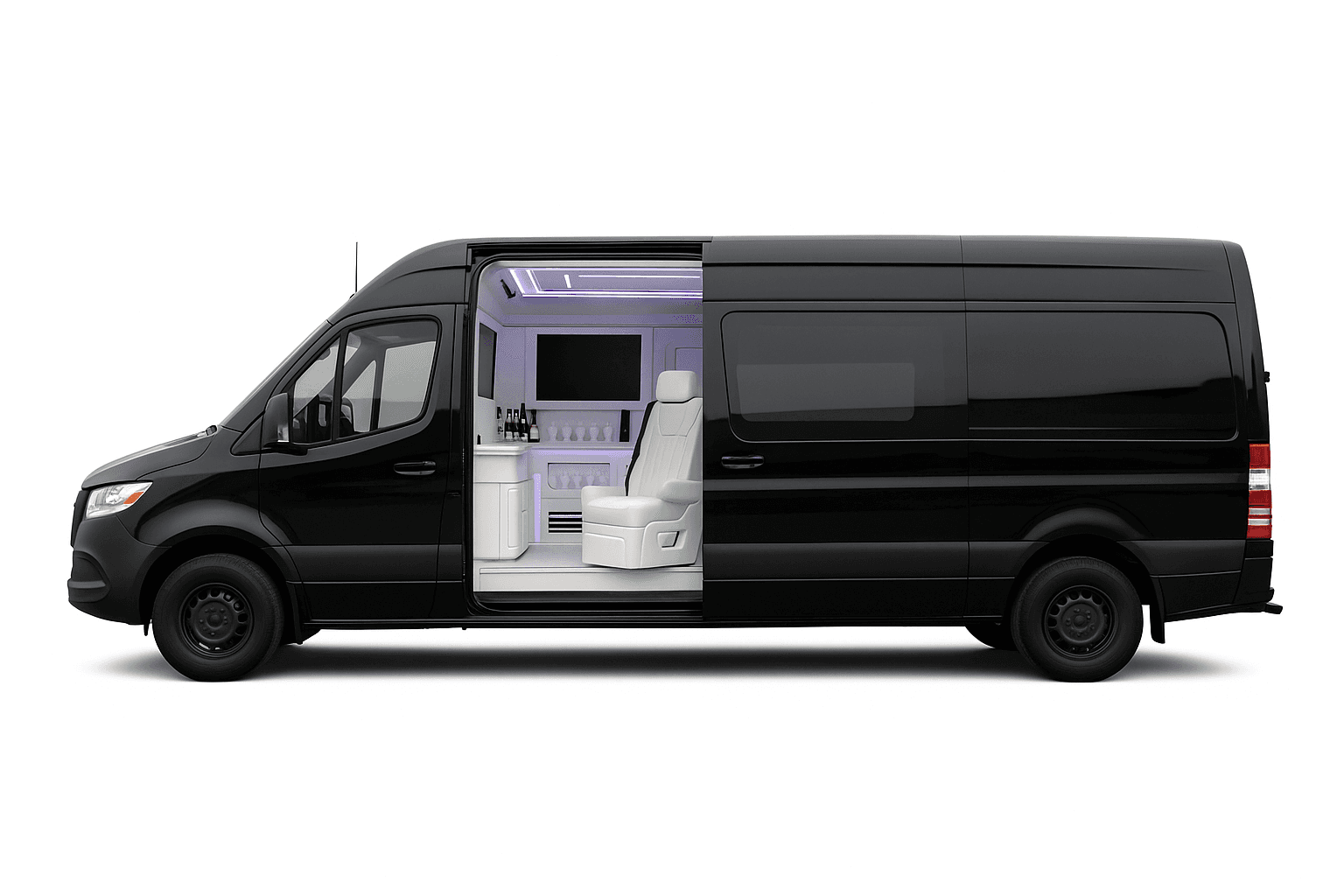
Sprinter Van
Groups, cruise transfers, and event movement
A Sprinter keeps a group together instead of splitting the itinerary across multiple cars. Use it for cruise luggage, event evenings, corporate teams, and airport transfers where coordination is the real value.
Coverage
BWI routes, Washington airports, and Baltimore anchors
Airports
- BWIBaltimore/Washington International Thurgood Marshall Airport
- DCARonald Reagan Washington National Airport
- IADWashington Dulles International Airport
How It Works
A cleaner airport transfer, step by step
Request
Send flight number, pickup details, passengers, luggage, and whether you prefer curbside or meet-and-greet.
Quote
Dispatch prices the actual itinerary and confirms the sedan, SUV, or Sprinter before the trip is booked.
Track
Arrivals are flight-tracked; departures are timed against pickup point, traffic, and airport conditions.
Ride
Your chauffeur stages as instructed, handles the airport handoff, and completes the transfer without app roulette.
What Baltimore airport car service actually covers
As of 2026, Baltimore Airport Car Service is reserved, chauffeured transportation arranged before travel rather than requested at the curb. A specific vehicle and a specific chauffeur are committed to your trip, a price is agreed in advance and does not move, and a dispatcher holds the booking with knowledge of your itinerary. That is the whole product, and everything else follows from it.
The operation is built around BWI Marshall, which is where most of the volume sits and where the operational knowledge is deepest. BWI is a five-concourse airport with a single connected terminal, and the pickup mechanics (the managed arrivals curb on the lower level, the hourly garage, and cell-phone lot staging that keeps chauffeurs from circling) are specific enough that knowing them well makes a real difference to how an arrival feels.
Beyond BWI, the two Washington airports are covered as corridor destinations. DCA is roughly an hour from Baltimore and IAD commonly ninety minutes or more at peak, so these are longer and more expensive transfers than a local BWI run and are planned accordingly rather than treated as airport hops.
The other fixed points are the Baltimore Cruise Terminal at South Locust Point, the BWI Rail Station, the Johns Hopkins campus, and the Baltimore-area destinations that generate the most airport traffic: downtown and the Inner Harbor, Annapolis, Columbia and Towson.
How pricing works here
Most of this industry quotes only on request, which makes comparison genuinely difficult. Hourly floors are published instead: sedan from $120 per hour, SUV $150, S-Class $230 and Sprinter $240, with a three-hour minimum on hourly hire.
Those are floors rather than final prices. The actual figure for a specific trip depends on the itinerary, the timing and the vehicle class, and point-to-point airport transfers are quoted for the journey rather than by the hour. What the published floors tell you is whether this is in your range before you spend time on an inquiry, which is a reasonable thing for a buyer to want.
The quote agreed at booking is the price at travel. It does not move because demand rose, because the weather turned, or because three flights landed in the same window. That fixed structure is the practical difference from dynamically priced alternatives, and it is why a finance team can budget against a ground transportation line rather than treating it as variable.
The three-hour minimum on hourly hire exists because an hourly booking commits a vehicle and chauffeur to you for a block during which they are not available for other work. For itineraries that genuinely suit hourly hire (a day of meetings, a multi-stop corridor trip, an event evening), three hours is close to what the day needs anyway. For a single transfer, point-to-point is cheaper and is the right structure.
Full rate detail, including the waiting policy and what is included, is on the rates page.
Flight tracking, and what it is actually for
Flight tracking is claimed by nearly every operator and the phrase has been used loosely enough that it is worth being precise about what it does.
Give the operating airline and inbound flight number when booking. Confirm how early arrivals and delays affect dispatch timing, the waiting start and charges. Flight tracking alone does not promise an unlimited free waiting period.
What tracking cannot see is how long you will take at baggage claim, whether your bag came off the aircraft, or whether customs held you. It gets the vehicle to the right place at approximately the right time; the last fifteen minutes are coordinated between you and the chauffeur directly.
For connecting itineraries, give the final inbound segment rather than the origin. The Chicago-to-BWI flight determines when you appear at the curb, not the one that left the west coast that morning.
For a diversion or cancellation, contact the operator and confirm the revised pickup, availability, price and cancellation terms. Keep the day-of contact details with the booking.
Choosing the vehicle
Vehicle class is decided by luggage volume far more often than by seat count, and nearly every mismatch traces back to a booking that described passengers rather than bags.
A sedan takes two passengers with two large cases, or three traveling light. An SUV handles two to four passengers with up to four large cases and is the default for families, whose equipment inflates the effective luggage count well beyond the headcount. A Sprinter is for five or more, or for any party with cruise-scale luggage, which routinely runs to two large cases per person.
The S-Class carries the same as a standard sedan and exists for a different reason: the impression made at the curb when the passenger is a client, a board member or a senior candidate. It is a presentation choice rather than a space one, and for routine travel it is unnecessary.
Child seats are fitted before the vehicle leaves when ages and weights are given at booking. Mobility equipment should be described by type: a folding manual wheelchair fits an SUV alongside reduced luggage, while a powered chair or scooter generally needs a Sprinter.
The most useful sentence you can send dispatch is a bag count. Two adults, four large cases, two carry-ons is a complete brief; two adults is not.
When a reserved car is not worth it
Being straight about this is more useful than claiming the service suits everyone.
Short local trips with flexible timing do not need it. If it does not matter whether you arrive at seven or seven twenty, a reserved vehicle is buying certainty you will not use.
Solo travelers with hand luggage on midday flights are similarly poorly served by the premium, because every failure mode reserved service protects against is absent from that trip.
Genuinely spontaneous travel is a real limitation rather than a preference. Reserved service works by committing a vehicle in advance, and an hour's notice removes most of that advantage while availability may be poor.
Where it is not optional: cruise embarkation, where the ship sails without you; client and executive travel, where someone else's impression of your company is formed at the curb; anything with a hard onward deadline; groups of five or more with luggage; medical transport with mobility equipment; and pre-dawn airport runs where supply is thin and the consequence of no ride is a missed flight.
The Baltimore-Washington geography, briefly
Ground transportation here is shaped by the fact that this is a corridor rather than a single city, and journey times vary more than visitors expect.
From BWI, downtown Baltimore is around twenty minutes off-peak and Columbia twenty to thirty, which makes both short, predictable runs. Annapolis and Towson are typically forty to fifty minutes. The cruise terminal at South Locust Point is thirty to forty. Washington is an hour off-peak and ninety minutes to two hours during weekday peaks, while IAD is the longest transfer in the region from a Baltimore address.
Two roads carry most of the corridor traffic and neither is reliably better. I-95 is the high-capacity route and is fast when clear, slow when not, with incidents propagating a long way. The Baltimore-Washington Parkway is lower-speed but frequently more predictable. A chauffeur checks both before departure rather than defaulting to one.
The pinch points worth knowing about are the Fort McHenry Tunnel on the cruise terminal and southbound approaches, the Beltway at the Maryland approaches during peak, and the Jones Falls Expressway from the northern suburbs, which is steep, curving and handles poorly in ice.
Maryland winter weather deserves a mention because the region handles snow intermittently rather than routinely, which means disruption is disproportionate when it arrives. On those mornings the answer is an earlier pickup rather than a cleverer route, and dispatch will recommend it rather than holding to a schedule set in better conditions.
Baltimore airport car service questions
What is Baltimore airport car service?
Baltimore airport car service is reserved private transportation focused on BWI Marshall arrivals and departures, with flight tracking, terminal pickup coordination, and a chauffeur assigned before travel day.
Do you serve BWI Marshall Airport?
Yes. BWI Marshall is the primary airport, including concourses A through E, curbside pickup, hourly garage pickup, cell-phone lot staging, and meet-and-greet by request.
Can I book DCA or IAD transfers from Baltimore?
Yes. DCA and IAD transfers are available by reservation for Washington DC runs, corporate travel, and longer corridor itineraries.
What happens if my BWI flight is delayed?
Share the operating airline and inbound flight number. Confirm delay, diversion and cancellation handling, the waiting start and any charges in the written quote.
Do you publish BWI transfer prices?
Hourly floors are published rather than held back until an inquiry: sedan from $120 per hour, SUV $150, S-Class $230 and Sprinter $240, with a three-hour minimum on hourly hire. Point-to-point airport transfers are quoted for the specific itinerary, vehicle class, pickup method, stops and waiting time before confirmation, and the quote is fixed at booking.
Is there surge pricing on Baltimore airport transfers?
The displayed estimates do not include a separate peak-time charge. Confirm your date, itinerary and the full written quote; changes to the trip can require a revised quote.
Should I book hourly or point-to-point?
Point-to-point for a single pickup and drop. Hourly once a day has roughly three or more movements, because one vehicle waiting between commitments costs less than several vehicles each traveling to you, and an overrunning meeting moves the schedule rather than requiring a re-booking. Describe the whole day to dispatch for a straight answer on which is cheaper.
Can you handle Baltimore Cruise Terminal transfers?
Yes. Private transfers to and from the Baltimore Cruise Terminal at South Locust Point can be arranged from BWI, hotels, rail stations, and local addresses.
Plan your BWI transfer
Check your itinerary and vehicle
Booking requests use Detailed Drivers through MyLimoBiz. Enter the exact pickup, destination, date, passengers and luggage. Review the vehicle, price and terms before accepting; a request alone is not a confirmed reservation.
If the form does not load, open booking directly. See our privacy notice before entering personal details.
Reservations
Plan your BWI transfer before the flight moves.
Send the flight, pickup notes, passengers, luggage, and destination. Dispatch returns a clear quote and coordinates the airport handoff.